
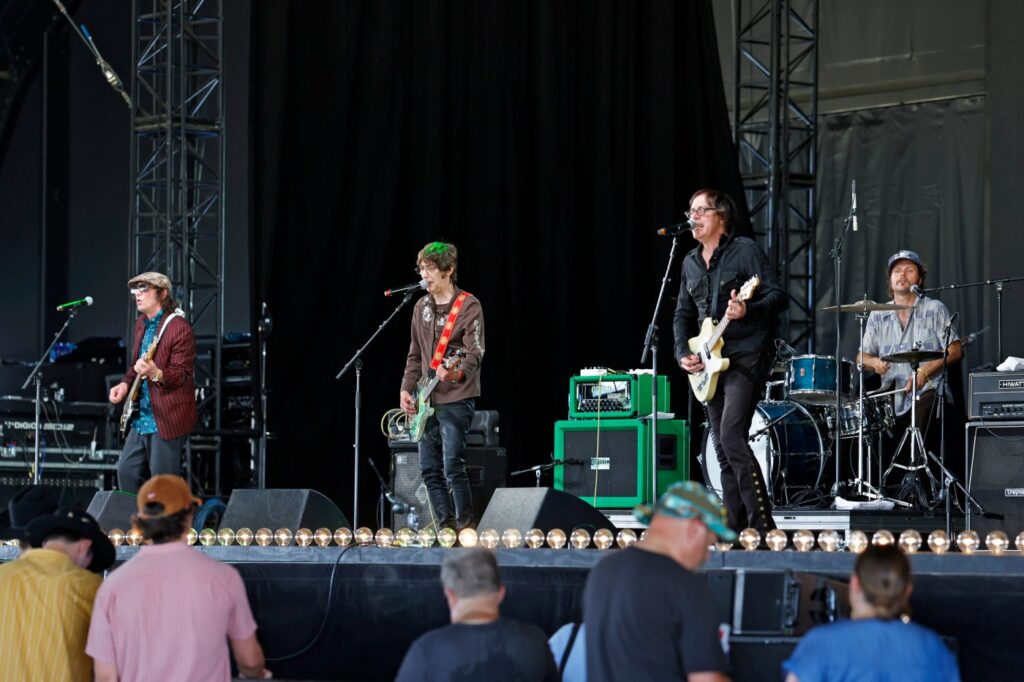
Six decades after the fact, Cyril Jordan doesn’t waver when asked how the Flamin’ Groovies, one of rock’s favorite cult bands, found its name.
“We were the Chosen Few, which I thought was extremely pretentious,” says Jordan, who was 16 or 17 when he, singer-guitarist Roy Loney, guitarist Tim Lynch, bassist George Alexander and drummer Ron Greco formed the band in 1965.
“Then we found out there were like 15 Chosen Fews in the Bay Area, so they changed the name to the Lost and Found,” he says. “Which was better than the Chosen Few, but it wasn’t that great.
“We didn’t become the Flamin’ Groovies until the day after the Beatles‘ last concert in ’66,” Jordan continues. “Roy took me to the show. He had an extra ticket because he’d just broken up with his girlfriend.”
That was Aug. 29, 1966, when the Fab Four played Candlestick Park, the final time they’d ever play live for a ticketed audience.
As for the why of that name, well, it was San Francisco on the eve of the Summer of Love, so take a wild guess.
“There was a phrase going around at the time that a marijuana cigarette was a flaming groovy,” Jordan says. “You light up a flamin’ groovy, right?
“So anyway, this one day after the Beatles show, I was so excited, and we were all smoking pot. Roy says that I was running around saying, ‘Groovy!’ every time somebody said something.
“I was just totally crazed. And he said, ‘He’s a flamin’ groovy!’ That’s basically where we got the idea from.”
If you’ve heard the band’s music – 1971’s “Teenage Head,” a greasy blues rock album that impressed Mick Jagger and Keith Richards, who knew a thing or two about that sound, or maybe 1976’s “Shake Some Action,” a cornerstone of power pop – good for you.
If you’ve only heard the name, well, that’s a start. And you might have, given they played the Palomino Stage at Stagecoach in 2023. But if the Flamin’ Groovies ring no bells, let’s catch you up.
Despite rising on the tides of San Francisco’s Haight-Asbury scene, the Flamin’ Groovies were more about garage-blues rock than the psychedelic jams of such contemporaries as the Grateful Dead or Jefferson Airplane.
And they were contenders early on, as major labels scooped up San Francisco bands like unscratched lottery tickets. But sales were poor and singer-guitarist Loney and guitarist Lynch left the band. Now led by Jordan, with new singer Chris Wilson, the Flamin’ Groovies relocated to England, where their shift toward a punky power-pop sound found more favor than at home.
The band played the United Kingdom steadily for a year or so. They played a legendary gig at the Roundhouse in London on July 4, 1976, that featured the Ramones, whose intense and melodic punk music electrified the crowd and greatly influenced the rising punk scene, as the opening act.
The Flamin’ Groovies’ 1976 album “Shake Some Action” marked its debut on Sire Records. The title track is the band’s best-known song, and was chosen by rock scholar Greil Marcus as the leadoff song in his 2014 book “The History of Rock ‘n’ Roll in Ten Songs.”
The Flamin’ Groovies come to Southern California from Nov. 19 to Nov. 22 for shows in Hermosa Beach, San Diego, Yucca Valley and West Hollywood.
In an interview edited for length and clarity, Jordan, now 77, and the only original member of the band still playing, talked about its origins six decades ago, how it made its deepest impact on the British music scene, why he still loves traveling with the band today, and more.
Q: Tell me how you and Roy and the other guys first found each other.
A: Well, there was a bowling alley pretty close to the Cow Palace on Geneva Street. They had a pool hall, so I used to go there after dinner when I was in school. Every night I’d walk there and play pool. And one night, I’m talking to my girlfriend on the phone in a phone booth, and I see this guy with a Beatle haircut playing harmonica.
I said, “Listen, let me call you back.” So I walked over and started talking with him, and that was George Alexander. We started finding out that we both were playing instruments and had potential ideas for a band. George said, “Well, listen, why don’t you come over and meet the guys I’m working with?” I did and that was Roy and Timmy, and I brought Ron along.
We ended up in Timmy’s living room playing music. After about an hour and a half, we realized we had a group. We could play an hour’s worth of music without any trouble.
Q: You were just playing songs you all knew? Not yet writing songs?
A: What we were doing was what all the garage bands were doing back then. Everybody was playing “Gloria” by Them. They were also doing Yardbirds’ songs, “Mister You’re a Better Man Than I.” “Tobacco Road” by the Nashville Teens. That was pretty much the catalog for garage bands in California. “Baby Please Don’t Go.”
Everybody said, “What should we do?” And so I started the intros, because I didn’t know how to play guitar chords. I only knew solos and intros because that’s what I had been learning.
Q: So it took a little while before you could get into the studio and make that first EP? But you were playing gigs around town?
A: We were gigging a lot at the Matrix, which was run by [Jefferson Airplane singer-guitarist] Marty Balin’s father, and we were playing the New Orleans House in Berkeley. We were gigging about four times a week.
Q: Were you still in high school or did you leave?
A: No, while I was still going to Balboa High School. It just evolved. Then it got to the point where the music scene in the city was just starting to thrive. We were the youngest players in the Haight Ashbury music scene. All those other bands, the Quicksilver, the Airplane, the Dead, all those guys were out of college. We were just the babies of the scene.
Q: Why did things stall and fall apart a little after “Teenage Head” came out in 1971?
A: We cut “Teenage” at Christmas 1970. And unfortunately, Timmy got busted for drugs and couldn’t make the session until the last couple of days. We recorded for four weeks, five days a week. And Roy wanted to stop playing guitar and do more of a [Mick] Jagger thing, so we get to the studio in New York and I’m the only [guitarist].
I think what happened, and I didn’t realize this back then, but in the years and decades that came after that period, I realized that Roy had started this thing with his best friend Timmy. When they were like 11 years old they had a hootenanny-type acoustic thing going.
I think Roy got really depressed that Timmy was gone and lost interest. It got to the point where we realized, “Wow, you don’t really want to do this anymore, maybe you should move on.”
Q: So they left to do their own thing, and you found others to join the Flamin’ Groovies.
A: You step up when you’re in a band. If you lose a member, like the Beatles did with Stu Sutcliffe, who was their bass player, what happens instead of the band breaking up is Paul steps up and now he’s playing bass. So I went out there without any idea what the hell I was going to do and figured it out real quick.
Q: Soon after you got Chris Wilson as the new singer, the band starts going to England regularly. How’d that happen?
A: Because we were the house band at the Whisky for two summers in a row, so we got a lot of exposure to people in the industry. One day, Ike Turner and Gerhard Agustin, his manager, came backstage and talked about how they liked the band and how they wanted us to open for them when [the Ike and Tina Turner Revue} did gigs in California. So I became good friends with Ike and Gerhard.
Gerhard was with United Artists in the building in L.A., and Gerhard told me it might be a better move to go to England. It really looked like an impossible mountain to climb here in America. And we were being edged out. The avant-garde of American guitar rock and roll bands at the point where the Flamin’ Groovies, Iggy and the Stooges, the MC5. And we weren’t getting anywhere.
Q: So you signed with UA in England. What was the reception like when you got there?
A: Our first gig in London, when we got there in ’72, was at the Bickershaw Festival. We played in front of 250,000 people.
Q: Wow, a little bit different than back home.
A: The Kinks were on right before us. Then the Dead went on after us, and then Cheech and Chong. You know, big, big people were on this show, and I don’t know how the hell we got on, but we did. We made quite an impression.
We started there for the whole year. I think we must have done over 100 shows, playing France and England and Scotland.
Q: Let me ask you about “Shake Some Action,” because that song is one of the classic power pop songs.
A: It took me three months to write it. In late ’71, I began writing again, without Roy. And I came up with parts. The way I write, I write in small sections. I’ll figure out an intro, and if it’s really cool I’ll build on that and try to figure out a verse.
So I had three songs I was working on and I couldn’t finish. I couldn’t get any more ideas. So I decided to put all three together and that was “Shake Some Action.”
Q: You recorded it and some other songs in 1972, but nothing came out until ’76.
A: I recorded “Shake Some Action,” “Slow Death” and “You Tore Me Down” at Rockfield [with producer Dave Edmunds] in April of ’72. I gave [United Artists] three genres of music to choose for a single and they chose “Slow Death,” which shows you how ridiculous this company was. These are English people and they don’t know that the BBC bans words like morphine? So they put out “Slow Death” and it gets banned by the BBC immediately.
They told us at the end of the year, “We’re going to send you home for Christmas and you’ll come back.” Well, we never came back. That was their way of getting rid of us. So we ended up owning all of the masters of the recordings we made, and I started to shop those tapes.
Q: Eventually, you signed with Sire and Seymour Stein, and somehow that led to the Flamin’ Groovies playing a lot with the Ramones and other punk bands.
A: I became good friends with Seymour’s wife Linda, because Linda was a real pothead. I would bring California skunk to the East Coast. She thought I had the best pot on the planet. So we became really good friends, and one day she said she was managing a group called the Ramones.
She gave me a cassette and I put it on that night, and I heard “I Wanna Be Sedated” and I laughed my head off. So I told Seymour, “Seymour, I’m going to take them to Europe. They’re going to open for us on the next tour.” Linda discovered them, but I fanned the flame.
And we took them to England maybe 17 times during that Sire period [Flamin’ Groovies released three albums with Sire between 1976-79]. That Roundhouse show was a killer. People are still talking about it.
Q: What happened at the start of the ’90s that led to the end of the band for years?
A: We did a tour in late ’89 and early ’90 that was just a horror show. I find out halfway through the tour that we’re not only going not going to make any money, we’re going to be in debt about 10,000 pounds. I thought, “We’re going back home.” I called the agent and told him, and he goes, “No, you can’t do that.” We had like 60 more shows.
So I told him, “Listen, man, the only way I’m going to finish this is that I’m picking up the rest of the money now.” This was a way for me to be able to pay the guys at the bank. The only food we were eating was the food that was on the table backstage at every show.
We come back from that just exhausted and depressed, and the band just fizzled out right at that point.
Q: What did you do next?
A: From 1991 to about 1996, I started getting back into art [Jordan’s early art career included designing many of the band’s album covers.] I had gotten a job in ’87 doing Mickey Mouse comic book covers for Walt Disney Comics. So I thought I should put an art resume together. I didn’t play guitar, I didn’t listen to rock and roll records for about five years.
Then one day, I get a letter in the mail from Paramount Studios. It’s this director, she’s going to make a movie, and she wants to use “Shake Some Action.” That movie was “Clueless” [which featured Cracker’s cover of the song.] I get a check for $15,000. I make more money when I’m not back in the biz.
Q: Flamin’ Groovies reunited about a dozen years ago. How’d that happen?
A: In 2013, I get a knock on the door one day, and it’s George [Alexander] and Chris [Wilson]. They want to put the band back together because we apparently got an offer from Australia to open for Hoodoo Gurus and make about $80,000 or something. So we put the band back together, and here I am now. I’m sucked back into it. [He laughs]
Q: What’s it been like to have this coda or postscript?
A: Well, you know, the damn thing should have died out a long time ago. I still can’t figure out why it ain’t dead. It’s like gum on my shoe; I can’t get rid of it. When we started touring the world again in 2013, playing Japan, Australia, Europe, it was fantastic.
In the old days, I didn’t like driving for eight hours for it. Nobody did. You get stir crazy in the van. Here I am, an old geezer, and I’m back on the road and I’m going to Italy. I’m looking out the window, going, “Man, this is great.” I couldn’t believe how cool it was to do this as an old guy.
Related Articles
Punk veteran Frank Meyer takes a walk on the pop side in first solo album
Singer-songwriter King Princess brings ‘Girl Violence’ to Southern California
Lamb of God, Kublai Khan TX, and more are coming to Los Angeles in April
Mötley Crüe announce 2026 North American tour with Long Beach Bowl stop
Post Malone, Jack White, Lil Jon to headline Thanksgiving 2025 NFL halftime shows
Recent Comments