
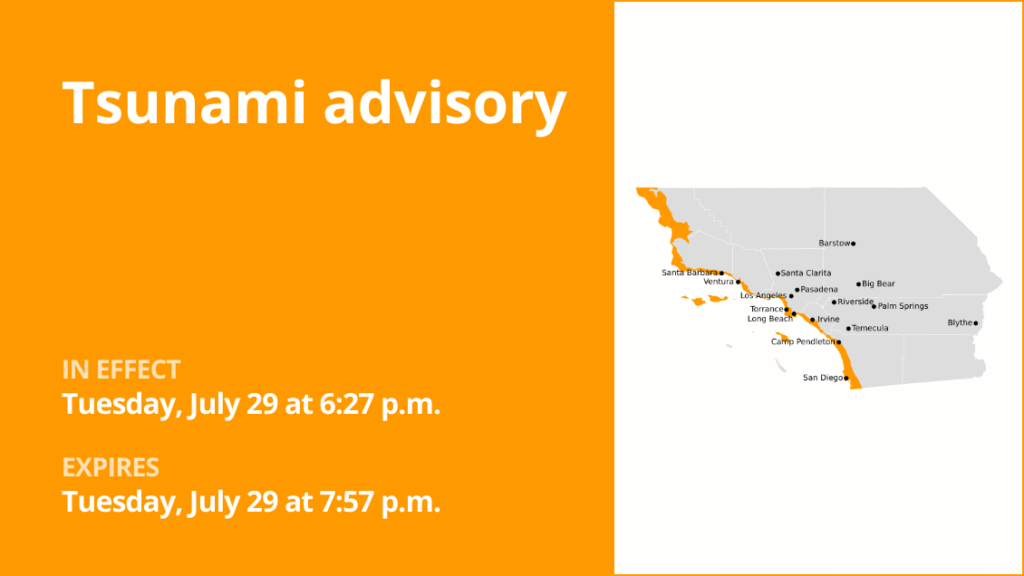
Orange County is under a tsunami advisory which was released by the National Weather Service on Tuesday at 6:27 p.m. The advisory is in effect until 7:57 p.m.
“If you are located in this coastal area, move off the beach and out of harbors and marinas. Tsunami advisories mean that a tsunami capable of producing strong currents or waves dangerous to persons in or very near the water is expected or is already occurring. Areas in the advisory should not expect widespread inundation. Tsunamis are a series of waves dangerous many hours after initial arrival time. The first wave may not be the largest. At 4:25 p.m. Pacific Daylight Time on July 29 an earthquake with preliminary magnitude 8.7 occurred 80 miles southeast of Petropavlovsk Kamchatka. Estimated tsunami start times for selected sites are; Langara British Columbia 10:05 p.m. PDT. July 29. Tofino British Columbia 11:30 p.m. PDT. July 29. La Push Washington 11:35 p.m. PDT. July 29. Neah Bay Washington 11:40 p.m. PDT. July 29. Port Orford Oregon 11:40 p.m. PDT. July 29. Long Beach Washington 11:45 p.m. PDT. July 29. Charleston Oregon 11:45 p.m. PDT. July 29. Brookings Oregon 11:50 p.m. PDT. July 29. Fort Bragg California 11:50 p.m. PDT. July 29. Moclips Washington 11:50 p.m. PDT. July 29. Westport Washington 11:55 p.m. PDT. July 29. Seaside Oregon 11:55 p.m. PDT. July 29. Newport Oregon 11:55 p.m. PDT. July 29. Crescent City California 11:55 p.m. PDT. July 29. Monterey California 12:15 a.m. PDT. July 30. Port Angeles Washington 12:20 a.m. PDT. July 30. Port San Luis California 12:35 a.m. PDT. July 30. San Francisco California 12:40 a.m. PDT. July 30. Port Townsend Washington 12:45 a.m. PDT. July 30. Santa Barbara California 12:50 a.m. PDT. July 30. Los Angeles Harbor California 1:05 a.m. PDT. July 30. Newport Beach California 1:10 a.m. PDT. July 30. Bellingham Washington 1:10 a.m. PDT. July 30. Oceanside California 1:15 a.m. PDT. July 30. La Jolla California 1:15 a.m. PDT. July 30. Tacoma Washington 2 a.m. PDT. July 30,” according to the NWS National Tsunami Warning Center.
The full list of affected locations includes:
Orange County Coast
San Pablo Bay, Suisun Bay, the West Delta and the San Francisco Bay north of the Bay Bridge
San Francisco Bay South of the Bay Bridge
San Diego County Coastal Areas
Ventura County Beaches
Malibu
Los Angeles County Beaches
Palos Verdes Peninsula
Catalina/Santa Barbara Islands
San Miguel/Santa Rosa Islands
Santa Cruz/Anacapa Islands
Santa Barbara County Southwestern Coast
Santa Barbara County Southeastern Coast
San Luis Obispo County Beaches
San Luis Obispo County Inland Central Coast
Santa Lucia Mountains
Santa Barbara County Central Coast Beaches
Northern Monterey Bay
Southern Monterey Bay/Big Sur Coast
Coastal North Bay Including Point Reyes National Seashore
North Bay Interior Valleys
San Francisco Bay Shoreline
San Francisco Peninsula Coast
Mendocino Coast
Southwestern Humboldt
Northern Humboldt Coast
Coastal Del Norte
South Central Oregon Coast
Curry County Coast
Central Coast of Oregon
Clatsop County Coast
Tillamook County Coast
South Washington Coast
Lowlands of Western Whatcom County
Lowlands of Western Skagit and Northwestern Snohomish counties
Port Townsend area
Eastern Strait of Juan de Fuca
Western Strait of Juan de Fuca
Northern Washington Coast
Grays Harbor County Coast
Lower Chehalis River Valley
San Francisco County
San Juan County
Island County
Navigating tsunami alerts: What each level means
Tsunami alerts are your first line of defense in coastal regions. Here’s a breakdown of the four-tiered alert system from the NWS and what each level entails:
Tsunami warning: Immediate action required
This alert is issued when a tsunami that could result in widespread flooding is either expected or already underway. It comes with the potential for dangerous coastal flooding and powerful currents that may persist for hours or even days after the initial wave. Local officials will provide instructions, and evacuation is often recommended, directing individuals to move to higher ground or inland, away from the shoreline.
Tsunami advisory: Exercise caution
A tsunami with potential for strong currents or waves dangerous to those in or very near the water is expected or occurring. There may be flooding of beach and harbor areas. Stay out of the water and away from beaches and waterways. Follow instructions from local officials.
Tsunami watch: Stay prepared
A tsunami watch is triggered when a distant earthquake has occurred, and there is a possibility of a tsunami. People in the affected areas are advised to stay tuned for further updates and be ready to take action if required. While the threat isn’t immediate, preparedness is key.
Tsunami information statement: No immediate threat
This statement is issued when an earthquake has taken place, but there is either no threat or it was so distant that it poses no danger. In most cases, there is no potential for a destructive tsunami.
Remember, official warnings might not always offer ample time to react. Nature can provide early warnings, so if you’re near the coast and experience a significant or prolonged earthquake, witness sudden changes in sea levels, or hear unusual sounds from the ocean, take immediate action to move to higher ground. Your safety is paramount, and being aware of these alerts can be life-saving.
Recent Comments